
The job that taught me the most about hosting was a portfolio of twelve villas in Azeitão, just outside Lisbon. I was running alojamento local for a concierge company, and twelve homes meant twelve sets of guests arriving, settling in and getting confused, often all at the same time.
Multiply one guest's questions by twelve and your phone simply does not stop. "How do I connect to the Wi-Fi?" "Where do I park?" "How does the heating work?" "Which key opens the gate?" The same handful of questions, across a dozen properties, often late at night and in several languages.
I couldn't keep answering each one by hand. So I built one clear document per villa that told guests everything before they had to ask, and the volume of messages dropped dramatically. That was my first real Airbnb welcome book. Refining it across those twelve villas, and later through apartments and villas I rented out in Qatar during the World Cup and the apartments I manage today in Casablanca, is where everything in this guide comes from.
What an Airbnb welcome book actually is
A welcome book (some hosts call it a guest book, a house manual, or a digital guidebook) is the single place where a guest finds everything they need to enjoy your home without texting you. Wi-Fi, check-out time, how the coffee machine works, where to eat nearby, what to do if the power trips. And it isn't an Airbnb-only tool: the same book works just as well for a VRBO listing, a Booking.com guest or a direct booking, which is exactly why I wrote a separate guide on the vacation rental welcome book for hosts on other platforms.
It is not a legal formality and it is not decoration. Think of it as the quiet member of your hosting team: the one that works at 2 a.m. when you're asleep, speaks calmly when a guest is stressed after a long flight, and never gets tired of the same question.
Why it's the highest-leverage thing you'll make as a host
With twelve villas in Azeitão, I physically could not be at every check-in, and I certainly couldn't answer the same questions twelve times a day. The welcome book was what made managing that volume possible. Here's what a good one did for me, measurably:
- Fewer messages. My most common questions (Wi-Fi, parking, check-out) basically disappeared from my inbox.
- Calmer guests. People who know how things work relax faster. Relaxed guests leave warmer reviews.
- Better reviews, specifically. Guests would mention the book by name: "Everything we needed was explained." That sentence sells your next ten bookings.
- It scales. The same system that handled twelve villas in Portugal is what let me host under real pressure in Qatar and keep things calm in Casablanca today. It's the backbone of how I manage multiple properties at once without losing the standard.
If you only improve one thing about your hosting this month, make it this. It costs almost nothing and it touches every single stay.
What to put in your Airbnb welcome book
Across very different homes and very different guests, I've settled on a structure that holds up. Here it is.
Start with the first ten minutes
When a guest walks in, tired and travelling, they need a small number of things immediately. Put these right at the front, where they can't be missed:
- Wi-Fi name and password (and where the router is, in case it needs a restart).
- Check-in and check-out times, and exactly what to do on departure.
- Parking and access: where to park, and how to get through the gate or front door.
- How the basics work: heating or air conditioning, hot water, the stove, the coffee machine.
During the World Cup in Qatar, I'd have guests landing at all hours, sometimes several check-ins in a single day, arriving from completely different countries. I couldn't greet each one in person, so the first page of the book had to do it for me. Whatever your guest needs in their first ten minutes, make it impossible to miss. The arrival itself, the door code and getting in, deserves the same care; I cover it in my guide to a smooth Airbnb self check-in.
The house rules: say them kindly
Every home needs rules: no smoking, quiet hours, no unregistered guests, pool safety if you have one. Several of the Azeitão villas had pools and gardens, so rules around the pool and noise genuinely mattered. The trick I learned is tone. Rules written like a warning sign make people feel like suspects. Rules written like a friendly explanation get followed. I break this down with the exact wording I use in my guide to Airbnb house rules that actually work.
For the rules people forget mid-stay (Wi-Fi, check-out, no smoking), I also hang a few small printed signs around the home so the information is there exactly when it's needed. A clean set of printable house posters does this without making the place look like a hostel.
Your local recommendations: the part guests screenshot
This is where you stop being a property manager and start being a host. Guests came to your city for the city, not your sofa. In Casablanca, where I manage apartments today, the questions I get most are where to eat and how to get around, and a short, honest list of places I'd actually send a friend to gets mentioned in reviews more than the apartment itself.
Keep it specific and honest. Three genuinely great restaurants beat twenty you copied from a tourist site. Group them so they're easy to scan: coffee and breakfast; restaurants (a cheap one, a special one); groceries and pharmacy; and one "do this if you do nothing else" experience.
Safety and the boring-but-critical information
This is the section nobody thinks about until they need it. Include the location of the fuse box, the water shut-off, a fire extinguisher if you have one, the nearest hospital and pharmacy, and local emergency numbers. With twelve villas, anything I forgot to write down turned into a phone call (where to reset the power, how to stop a leak), so the safety section quickly earned its place. And with international guests, as I had throughout the World Cup, a clearly written local emergency number is not a detail; in the wrong moment it's the most important line in the whole book.
A short, human welcome note
Open the book with two or three warm sentences in your own voice. Who you are, why you love the place, how to reach you. It takes thirty seconds to read and it sets the emotional tone for the entire stay.
What this looks like in different types of property
The structure above holds everywhere, but the emphasis changes with the home. Here is how I weight it in practice:
- A city apartment or studio. Access and the neighbourhood are everything. Building door code, which floor, where the light switch for the stairwell is, honest parking advice, and how to get around. In my Casablanca apartments, the transport section (taxis, tram, what a fair fare looks like) gets read more than anything except the Wi-Fi.
- A family villa with a pool or garden. Safety and equipment come first. In the Azeitão villas, the pool rules, the garden gate, the alarm and the barbecue each earned their own clearly written entry, because every one of them had once been a late-night phone call.
- A remote or rural home. Guests can't fix problems by walking to a shop, so the book has to be self-sufficient: how the water heater and the fireplace work, what to do if the power trips, the nearest shop and pharmacy with real distances, and where the phone signal drops.
- An apartment hosting international guests. During the World Cup in Qatar my guests arrived from everywhere, at every hour. What mattered most: simple English, a short section on local customs (how taxis work, where to get a SIM card), and emergency numbers spelled out for someone who has been in the country for three hours.
If your home has appliances with a personality of their own (a tricky induction hob, a washing machine with mysterious symbols), give each its own short entry. I explain how I write those in my guide to appliance instructions guests actually follow.
What to leave out
A welcome book fails when it becomes a novel. Guests skim; they don't study. So I cut anything that isn't useful in the moment: long histories nobody asked for; rules repeated five times in five tones; instructions for appliances that aren't even in the home; walls of text with no headings.
If a guest can't find the Wi-Fi password in under ten seconds, the book is too long. Clarity beats completeness every time.
Digital, printed, or both?
Both: they do different jobs.
A printed copy lives in the home, usually on the kitchen counter or coffee table. It's the one a guest grabs the second they walk in. A digital copy (a PDF or a link) goes out before arrival, so guests can find the building, sort out parking and feel oriented before they even land.
Managing the villas, I sent the digital version with my check-in message and left a printed one on the table. The overlap is the point: whichever one the guest reaches for, the answer is there.
How to build one without losing a weekend
My first welcome book was an ugly text document. It worked, but it looked like a form, and a clumsy-looking book quietly undercuts an otherwise beautiful listing.
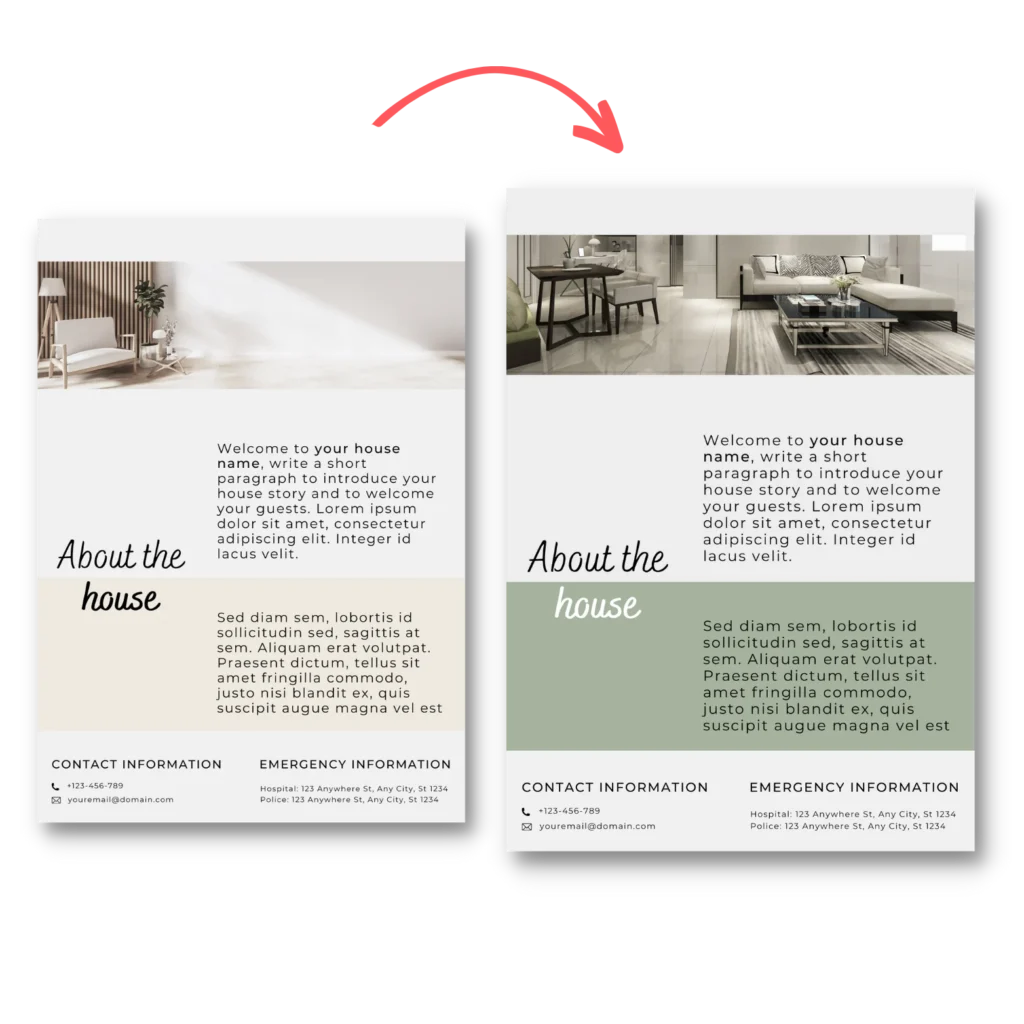
You don't need design skills, and you definitely don't need to start from a blank page. I now build mine from a ready-made Airbnb Welcome Book template and just swap in the photos, Wi-Fi details and recommendations for each property. It's fully editable in a free Canva account, so I can update it in a few minutes whenever something changes. If you host in one language, the English Welcome Book template is the simplest place to start.
The point is to spend your time on the content (your recommendations, your tone), not on fighting with margins and fonts. If you want to follow along click by click, I've written a step-by-step Canva tutorial for editing your welcome book.
Keeping it consistent across turnovers
A welcome book is only as good as the home it describes. If the book promises a spotless space and the guest finds yesterday's coffee cups, the book actually makes things worse. With twelve villas I couldn't be in all of them between stays, so I ran every clean off the same cleaning checklist, so nothing got skipped, whether I was doing it myself or handing it to a cleaner I'd never met. I wrote up the whole turnover system in my Airbnb cleaning checklist guide.
Consistency is what turns a nice property into a five-star brand. The book sets the expectation; the checklist keeps it.
The detail most hosts miss
Here's the thing almost nobody does: they write the welcome book once and never touch it again. The café you recommended closed. The Wi-Fi password changed. The check-out instructions are out of date. A guest follows your advice, hits a locked door, and now they trust nothing else in the book.
Treat your welcome book as a living document. I review mine regularly and after any guest question it failed to answer, because each of those questions is a gap the book should have closed. Your house manual deserves the same care; I go deeper on that in a separate guide on what to include in your house manual.
The mistakes I see most often
After years of reading other hosts' books (and getting my own wrong first), the same handful of mistakes keeps coming back:
1. Burying the Wi-Fi. If the password sits on page 14, the book has already failed. First page, always. 2. Writing rules like a contract. Ten paragraphs of legal tone make guests defensive before they've unpacked. Say it kindly once; it works better. 3. Copying recommendations from a tourist site. Guests can smell a list nobody has actually eaten at. Three honest places beat twenty generic ones. 4. Walls of text. No headings, no bold, no white space. Guests skim; a book that can't be skimmed doesn't get read at all. 5. *Choosing digital or printed. Each covers the other's blind spot. The PDF works before arrival, the printed copy works at the kitchen counter. 6. One language for international guests.* If half your guests book in Spanish or French, a book they can actually read is the cheapest upgrade you'll ever make.
None of these takes long to fix, and every one of them is invisible to you but obvious to your guest.
Frequently asked questions
How long should an Airbnb welcome book be?
Ten to sixteen well-organised pages is the sweet spot. Long enough to cover arrival, the house, your rules and your recommendations; short enough that a tired guest can still find the Wi-Fi in ten seconds.
Is a welcome book the same as a house manual?
They overlap, but no. The house manual is the technical half: how the heating, appliances and locks work. The welcome book wraps that inside the whole stay: the welcome note, the rules, the local guide, the practical details.
Do guests actually read it?
They read what is findable. Send the digital copy before arrival, leave the printed one where they drop their bags, and keep every section scannable. Nobody reads page 14 of anything; everybody reads a clear first page.
Will a welcome book really improve my reviews?
In my experience, yes, and it's the closest thing hosting has to a shortcut: guests who never had to ask for anything remember the stay as effortless. It's one of the habits I cover in how to get five-star reviews on Airbnb.
What should I build it with?
Anything beats nothing, but a Canva template gets you a polished, editable book in an afternoon: swap the photos, drop in your details, export the PDF, done.
Start your welcome book this week
If your phone lights up with the same guest questions every stay (and with a portfolio of properties, believe me, it does), your welcome book should be doing the answering for you. If you're only just becoming a host, it's the very first thing I'd build, because it shapes your reviews from your first guest onward. You don't need to be a designer and you don't need a weekend. Start with the first ten minutes, add your honest local recommendations, keep it short, and make it look like it belongs to your listing.
When you're ready, the fastest path is to start from a template you can make your own in minutes. Take a look at the BnB Welcome Book template, add your details, and you'll have a book your guests actually thank you for, long before they leave the review.