
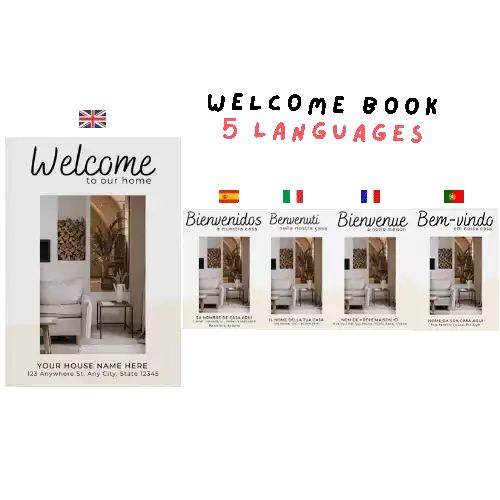
A house manual is the part of hosting that feels boring until the night a guest can't work the heating and messages you at midnight. I learned that fast running twelve villas in Azeitão: every piece of information I didn't write down came back to me as a phone call, usually at the worst possible time.
So this is the checklist I wish I'd had on day one: what actually belongs in an Airbnb house manual, what to leave out, and where the manual should live. If you want the wider strategy, this pairs with my complete guide to the Airbnb welcome book; think of the house manual as the practical core of that book.
House manual vs welcome book: what's the difference?
People use the terms interchangeably, and that's fine, but there's a useful distinction:
- The welcome book is the whole guest-facing document: warm intro, local recommendations, the lot.
- The house manual is the practical engine inside it: how this specific home works.
You can keep them as one document (I usually do) or split them. Either way, the manual is the part that prevents 90% of guest messages, so it's worth getting right.
The essentials every house manual needs
Entry and access
Exactly how to get in: the address that actually works in a map app, gate codes, key-box location and code, which key is which, and how to lock up on departure. Across the villas, "which key opens the gate?" was one of my most repeated questions until I put a photo of each key in the manual. If you offer self check-in, this section is doing the heavy lifting, and I go step by step through getting it right in my Airbnb self check-in guide.
Wi-Fi and connectivity
The network name and password, written exactly as typed (case-sensitive), and where the router is in case it needs restarting. Put this near the very front. It's the first thing most guests look for.
Appliances and how things work
Short, plain instructions for anything non-obvious: the oven, the washing machine, the dishwasher, the coffee machine, the TV. You don't need manuals: you need the two or three steps that actually get it working. I walk through exactly how to write these, with the simple format I use for each machine, in my guide to Airbnb appliance instructions.
Heating and air conditioning
How to turn it on, how to set the temperature, and any quirk ("the living-room unit takes a minute to start"). In Qatar, where I rented apartments and villas during the World Cup, the air conditioning instructions were non-negotiable: international guests arriving from cooler countries needed to get it right immediately.
Rubbish and recycling
When collection happens, which bin is which, and where the bins live. This is small and deeply local, and guests almost never guess it correctly.
Check-out instructions
A short, clear list: what time, where to leave the keys, whether to start the dishwasher, strip beds or not, windows locked. Ambiguous check-outs create awkward reviews; a five-line list prevents them.
Safety information (please don't skip this)
This is the section nobody reads until they need it, and then it's the only one that matters. Include:
- Location of the fuse box and how to reset a tripped switch
- The water shut-off valve
- Fire extinguisher / smoke alarm locations
- Nearest pharmacy and hospital
- Local emergency numbers
With twelve properties, the safety section earned its place purely through volume: a tripped fuse in one villa shouldn't cost me a 20-minute phone call. And with the international guests I hosted during the World Cup, a clearly written local emergency number isn't a detail; in the wrong moment it's the most important line in the whole manual.
House rules and where to repeat them
Put your rules in the manual in a friendly, explanatory tone: no smoking, quiet hours, pool safety, no unregistered guests. Then reinforce the few that get forgotten mid-stay with small printed signs placed exactly where they're needed: by the door, by the bins, in the kitchen. A tidy set of printable house posters does this without making your home look like a noticeboard. The manual explains once; the posters remind in the moment. For the exact wording that gets rules followed rather than ignored, see my Airbnb house rules examples.
Local and practical info
A house manual isn't only about the house. A short, honest set of local pointers turns a functional manual into a genuinely good one: a couple of restaurants you'd actually recommend, the nearest supermarket, how to get a taxi or use public transport, and one thing worth doing nearby. In Casablanca, where I manage apartments today, this is the section guests quote back to me most.
Keep it short and real. Guests trust five honest recommendations far more than a copied list of twenty.
What to leave out
A manual fails when it becomes a binder nobody opens. Cut:
- Long building histories
- The same rule stated five times
- Instructions for appliances the home doesn't have
- Anything a guest doesn't need during their stay
If a line doesn't help a guest do something, it's clutter.
The cold-read test: how I know a manual is good
Before I trusted a manual across the villas, I ran a simple test, and I still use it. Hand the manual to someone who has never set foot in the property and ask them to "check in" using only the document, with no help from you. If they can find the place, get through the door, connect to the Wi-Fi and work the heating without a single question, it passes. Wherever they get stuck is exactly the line you need to rewrite.
It works because the hardest gaps to spot are the ones you're blind to: you already know which key opens the gate and that the boiler switch is behind the kitchen door, so you forget to write it down. A cold reader doesn't know any of it, and they'll find every assumption you made in about five minutes.
Keeping manuals straight across multiple properties
With twelve villas, the real risk wasn't writing a manual: it was mixing them up. Villa 3's gate code in Villa 7's manual is worse than no code at all. Keeping the documents straight is part of the wider system I describe in my guide to managing multiple Airbnb properties, but for the manuals specifically, a few habits kept me out of trouble:
- Name every file by property, and put the property name and address at the top of each manual.
- Keep one master manual with the standard structure, then copy and customise it per home so the layout never drifts.
- Change only what's different between properties (Wi-Fi, access, recommendations), and leave the shared structure alone.
If you build in Canva, this duplicate-and-customise workflow is exactly what I walk through in my step-by-step Canva tutorial.
Where your house manual should live
Information only helps if guests can find it. I keep the manual in two places: a printed copy in the home (kitchen counter or coffee table) and a digital copy sent before arrival. The fastest way to produce both from one source is a proper template: I build mine from the BnB Welcome Book template, which already has these sections laid out, and export a print PDF and a digital PDF in a couple of clicks. If you'd rather follow the build click by click, I wrote a step-by-step Canva tutorial for exactly that.
A small touch that works well with phone-first guests: print a QR code that links to the digital version and stick it on the fridge or inside a kitchen cupboard. The guest scans it and has the whole manual on their phone, searchable, for the rest of the stay.
Start with the checklist above
Open a note, run down the sections in this article, and fill in the answers for your property. That note is your house manual: now you just need to make it look like it belongs to your listing. When you're ready, drop it into the Welcome Book template and read the full welcome book guide to tighten the rest. Your future self, at midnight, will thank you.