
The day I understood what managing multiple properties really means, I had four turnovers happening at the same time across four different villas, two guest arrivals, a broken water heater, and a phone that would not stop. This was Azeitão, just outside Lisbon, where I ran a portfolio of twelve villas for a concierge company. Alojamento local at that scale is not hosting one place twelve times. It is a completely different job, and the host who tries to do it the way they did with one property drowns within a month.
I know, because I nearly did. What saved me was not working harder. It was building systems that did the remembering, the standard-keeping and the answering for me, so that twelve properties ran like one well-organised operation instead of twelve small fires. Managing multiple Airbnb properties is a problem you solve with systems, not stamina, and this is what I learned doing it, refined later through the apartments I rented out in Qatar during the World Cup and the ones I manage in Casablanca today.
The mindset shift: you manage systems, not properties
With one property, you can hold everything in your head. You know the Wi-Fi password, when the bins go out, which guest arrives Friday. With three, your head starts dropping things. With twelve, relying on memory is professional negligence; something will always be forgotten, and the forgotten thing always becomes a guest problem.
The shift that made the difference was deciding that my job was no longer to do the tasks. It was to build the systems that made the tasks happen the same way every time, whether I did them or someone else did. The moment a process lives only in your head, it does not scale, because you cannot be in two villas at once on a Saturday changeover, and you certainly cannot answer the same question for twelve homes at midnight. Everything below is just that one idea applied to the specific places multi-property hosting breaks.
Standardise the guest experience across every property
When you run several listings, inconsistency is the silent killer. A guest who had a flawless stay in one of your homes and a confusing one in another does not think "different property." They think "this host is unreliable," and your whole portfolio carries the cost.
So the first system I standardised was the guest-facing one. Every villa got the same structure of welcome book, the same kind of clear arrival, the same tone of house rules, just with the specifics swapped per home. A welcome book template that works the same across every booking channel is what makes that consistency realistic to hold, and I explain that approach in my guide to the vacation rental welcome book. That sameness is what let twelve very different villas feel like one trustworthy brand. A guest moving from one of my properties to another found the information in the same place, explained the same way, and that consistency is exactly what reviews reward.
Doing this twelve times from scratch would have been impossible. The only reason it worked is that I built each property's guest experience from the same editable templates rather than reinventing it each time. I now set up every new property from the complete host toolkit bundle, which keeps the welcome book, checklists, posters and trackers consistent across the whole portfolio while letting me customise the details. When the system is one template applied twelve times, twelve properties stop feeling like twelve separate jobs.
Cleaning is where multi-property hosting lives or dies
If there is a single point of failure when you scale, it is the turnover. One property, you can clean on willpower. Twelve, on a packed Saturday, with some cleans handed to people who have never set foot in the home, willpower is worthless. The standard has to live somewhere outside any one person's head.
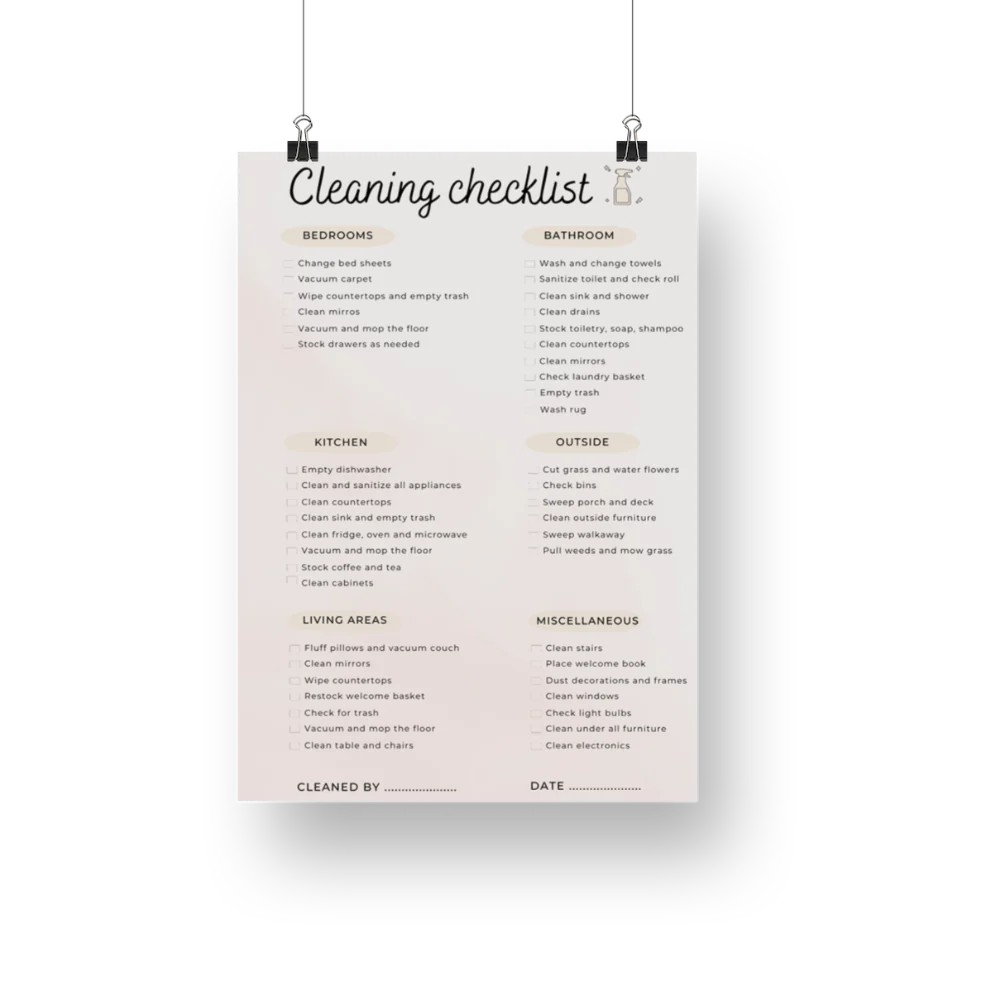
That somewhere is a written cleaning checklist, run identically in every property. Across the villas, the checklist did three things stamina never could. It kept the standard identical whether I cleaned or a stand-in did. It let me onboard a new cleaner in an afternoon, because the checklist taught them my standard instead of me hovering. And it created accountability: when a guest reported a problem, I could see exactly which step was missed and fix the process, instead of just hoping.
A great cleaner on a good day does a great clean. A checklist does a great clean on the chaotic days too, and at twelve properties, the chaotic days are most days. I keep the same room-by-room cleaning checklist in every home, printed and ticked, so the turnover standard does not depend on anyone having a good day.
Know your numbers per property, not in a lump
Here is the trap that quietly ruins multi-property portfolios: looking at one big pile of money coming in and assuming everything is fine. It hides the truth. Some of your properties are carrying the others, and until you measure per property, you have no idea which.
With twelve villas, I tracked income and expenses for each home separately, and the picture was eye-opening. Two of my busiest properties, the ones that felt like winners on the payout screen, were among my least profitable once I counted how often they needed repairs and how much each turnover cost. Without per-property numbers I would have invested more in exactly the wrong homes. I record it all in a per-property income and expense tracker, so each villa's real profit, occupancy and cost per turnover sits in one view. I explain the full method in my guide to tracking Airbnb income and expenses, and at multiple properties it stops being optional. It is the only way to know where to put your money and attention.
Centralise communication and the calendar
Twelve properties means a constant stream of messages, and many of them are the same handful of questions repeated across homes. Two systems tamed this.
First, the welcome book did most of the answering before guests ever messaged. The better each property's book, the quieter my phone, multiplied by twelve. Second, I kept a small set of message templates for the predictable moments (booking confirmation, check-in details, the first-evening check, check-out), always adding one human line per guest. Templates handled the volume; the personal line kept it warm. Without templates, you either burn out writing the same message from scratch a hundred times or you go silent, and silence reads as a bad host.
For the calendar, the danger at scale is the double booking and the missed turnover. Keep every property's calendar in one place you check daily, and treat the gap between a check-out and the next check-in as a hard operational deadline, not a suggestion. On the heaviest changeover days in Azeitão, the calendar was the difference between a smooth Saturday and a guest standing outside an uncleaned villa.
Build a team and a maintenance bench before you need them
You cannot personally be the cleaner, handyman, plumber and greeter for twelve homes. Long before something broke, I built a small bench of people I trusted: a couple of reliable cleaners who knew the checklist, a handyman, a plumber, an electrician. The time to find a good plumber is not when a guest is messaging about a flooded bathroom an hour before the next arrival.
The same logic applies to supplies. I kept a standard restocking list per property so consumables never ran out mid-stay, and so a stand-in could restock without asking me what goes where. Every recurring problem is a system waiting to be written down. Write it down once, and it stops being your problem twelve times over.
Protect yourself from the burnout that ends most portfolios
The real reason multi-property hosts quit is rarely money. It is exhaustion. If your phone owns you, twelve properties will break you no matter how profitable they are. The systems in this guide are not just about efficiency; they are what let me step back far enough to actually run the business instead of being run by it.
Once the welcome book answered the questions, the checklist held the standard, the tracker watched the numbers and the team covered the work, my job became managing the system rather than firefighting inside it. That is the only version of multi-property hosting that lasts. The host who scales their effort burns out at property four. The host who scales their systems can run twelve and sleep at night, which, after that four-turnover Saturday, was the whole point.
Scale the systems, not the stress
Managing multiple Airbnb properties is not about being everywhere at once. It is about building things that work when you are not there: a consistent guest experience in every home, a cleaning standard that survives a chaotic Saturday, numbers you can read per property, and a small team that knows your way of doing things. Get those in place and each new property adds income without adding chaos.
When you are ready to run your portfolio like one operation instead of many, start with the systems that carry the most weight. A per-property income and expense tracker tells you which homes are actually worth it, a consistent cleaning checklist keeps every turnover five-star, and the complete host toolkit keeps the whole guest experience identical across every listing. Build the system once, and twelve properties stop feeling like twelve jobs.