
The midnight messages that wore me down the most weren't about anything broken. They were about things that worked perfectly, if you knew the trick. "How do I turn on the oven?" "The washing machine won't start." "The AC is just blowing warm air." Every one of those was a guest standing in front of a perfectly good appliance, defeated by a control panel they'd never seen before, and every one of them landed on my phone at the worst possible hour.
I learned to head them off running twelve villas in Azeitão, just outside Lisbon, for a concierge company. Twelve homes meant a dozen different ovens, washing machines, dishwashers and coffee makers, each with its own quirks, and a constant stream of guests meeting them for the first time. Clear Airbnb appliance instructions were the only thing that stopped those quirks from becoming phone calls. This is how I write them now, so a tired stranger can work any machine in your home without ever needing to ask.
Why appliance instructions matter more than hosts think
An appliance a guest can't operate isn't a convenience, it's a frustration with your name on it. The guest who can't get the oven going doesn't think "tricky oven." They think "this place is awkward," and that small irritation quietly chips away at the review you were going to get. Worse, it interrupts you. Every appliance you don't explain is a question you've signed up to answer in person, at whatever hour the guest hits the wall.
There's also a real cost when guests guess wrong. A washing machine run on the wrong setting, an induction hob scratched by the wrong pan, an AC unit left blasting with the windows open for three days. Across twelve villas, I saw all of these, and almost every one traced back to the same root: I'd assumed the machine was obvious because I already knew it. The guest didn't, and nobody had told them.
Write for someone who has never seen the machine
The whole skill here is forgetting what you know. You've used your own oven a hundred times, so the unlabelled dial is obvious to you. To a guest it's a row of identical symbols with no clue which one bakes. Good appliance instructions assume zero familiarity and spell out the two or three steps that actually get the thing working.
For each appliance worth explaining, I keep it to a tight little block:
- What it is and where it is. "The dishwasher is the panel to the left of the sink." Obvious to you, not to them.
- The exact steps to use it, numbered. Not the full manual, just the path: which button, which setting, then go.
- The one quirk. Every machine has one. "The oven takes about ten minutes to heat up." "Press and hold start for three seconds." The quirk is the part that turns a working appliance into a support call when it's left out.
- A photo of the controls. A picture of the actual panel with the right button circled removes the guesswork that words can't. Across the villas, a single photo of each control panel cut my appliance questions more than any amount of writing.
The test is simple: could a guest who's never been in the home follow this and succeed on the first try? If there's a step you're holding in your head and not on the page, that's the step that becomes a message at midnight. It's the same cold-read habit I use for the whole house manual, and appliances are where it pays off fastest.
The appliances that actually need explaining
You don't need to write a paragraph about the kettle. Focus on the ones that genuinely confuse people, in roughly this order.
Heating and air conditioning
This is the big one, and the one I'd never leave to chance. Nothing makes a guest miserable faster than a home they can't get to a comfortable temperature. I learned exactly how much it mattered when I rented out apartments and villas in Qatar during the World Cup. Guests arrived off long flights into serious heat, from countries where the climate was nothing like it, and the very first thing they reached for was the air conditioning. If they couldn't work the remote, the stay started with a hot, irritated guest, which is the hardest possible place to begin.
So I spell AC and heating out completely: how to turn it on, how to switch between cooling and heating (the snowflake and the sun symbols mean nothing to a stressed traveller), how to set the temperature, and the quirks. "The living-room unit takes a minute to kick in." "Please close the windows when it's running." A line about not leaving it on full blast with the balcony door open saves you money and saves the guest a lecture.
The oven and hob
Ovens are quietly the most confusing appliance in any home, because no two control panels agree on anything. Tell guests which dial is temperature and which is the function, which symbol is the normal bake setting, and how long it takes to heat. For induction or ceramic hobs, add the one safety line that matters: the right pans, and "the surface stays hot for a while after you switch it off."
The washing machine
Long cycles and cryptic dials make this a classic source of "it won't start" messages. Give the one normal cycle you recommend, where the detergent goes, and the single step people miss, usually that the door has to click fully shut or the machine simply won't begin. You don't need to document every programme. You need the one that washes a guest's clothes without drama.
The coffee machine
People are loyal to their morning coffee and unforgiving when they can't make it. Whatever you have, pods or a proper machine, write the three steps to a working cup and say where the refills live. It's a small thing that lands big in the first ten minutes of a stay.
The dishwasher, the TV, and the rest
Short blocks for anything non-obvious: which button runs the dishwasher and where the tablets are, how to get the TV to the right input so the streaming actually shows up, how the heated towel rail or the robot vacuum works if you have one. Skip anything genuinely self-explanatory. Clutter buries the instructions that matter.
Where appliance instructions should live
Writing them is half the job. The other half is making sure the guest meets the instruction at the exact moment they need it, which is standing in front of the machine, not scrolling back through a chat thread.
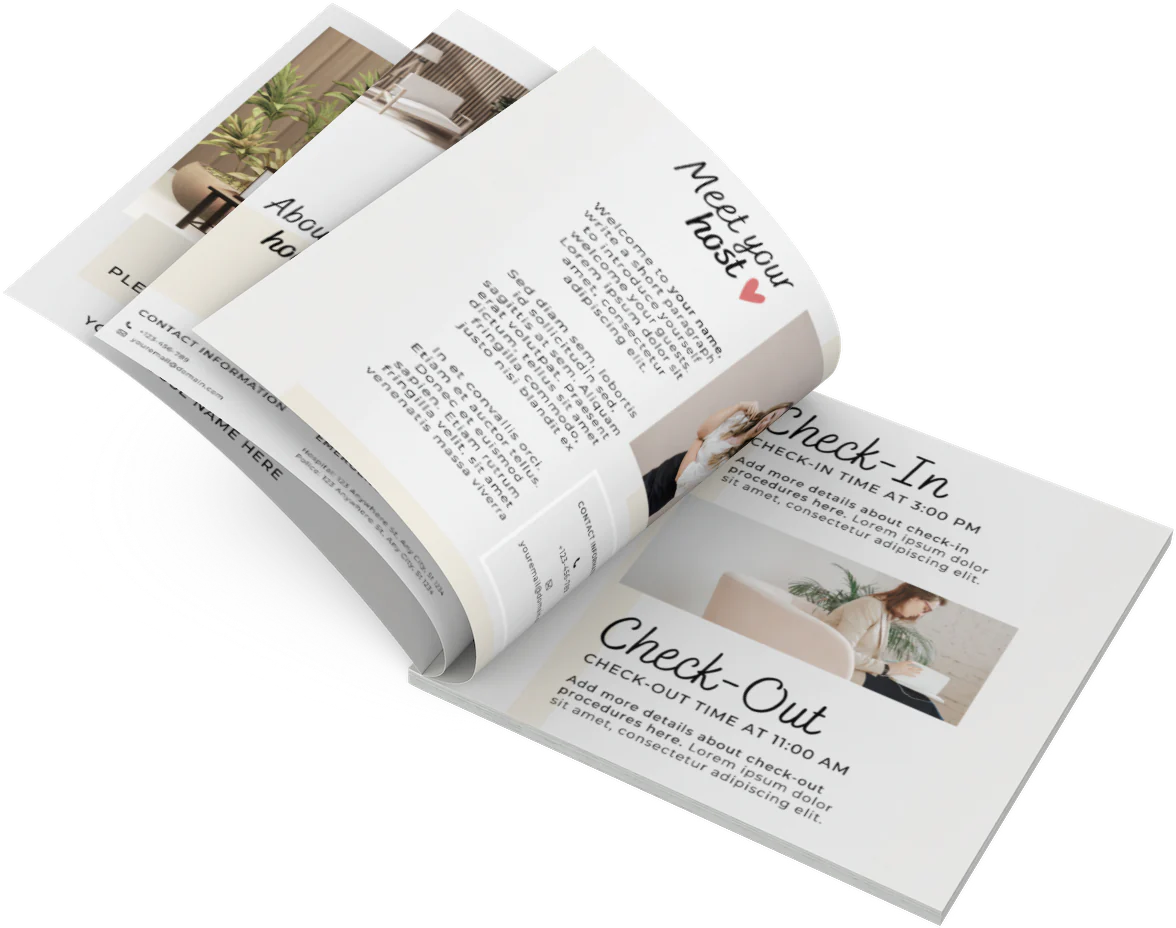
I keep appliance instructions in two overlapping places. The full set lives in the welcome book, grouped by room, so there's one calm reference for everything in the home. Then, for the few appliances guests struggle with most, I back the book up with a small, tidy printed sign placed right by the machine. A neat little card by the oven or taped inside the laundry cupboard lands at the precise second the guest is confused, and they never have to go hunting. A clean set of printable posters handles this without making the kitchen look like a laundromat noticeboard, and it keeps the whole home feeling considered rather than covered in sticky notes.
This matters even more for self check-in. When a guest lets themselves in with nobody there to demonstrate the AC or the hob, the written instructions are doing the entire job a host normally would in person. I treat the appliance notes as part of the same arrival experience as the door code, and I cover that whole handover in my self check-in setup guide.
Keep them updated and translation-friendly
Two last habits that save you grief. First, every time you replace an appliance, rewrite its instruction the same day. An out-of-date note pointing at a machine that's no longer there destroys a guest's trust in everything else you wrote. Second, keep the language plain and the steps short, because plenty of your guests will be reading in their second or third language. Throughout the World Cup, my instructions had to survive being read by someone who didn't speak much English and just wanted the air conditioning to work. Numbered steps, simple words and a clear photo travel across languages in a way that clever phrasing never does.
Start with the three machines guests ask about most
You don't need to document your whole home tonight. Pick the three appliances that generate the most questions, almost always the AC or heating, the oven, and the washing machine, and write a short, photographed, step-by-step note for each. Drop them into a proper welcome book template so they sit alongside everything else a guest needs, and print a small poster for the one or two machines people still get stuck on. Do that, and the midnight "how do I turn this on?" messages quietly stop arriving, which, after enough of them, is its own kind of luxury.