
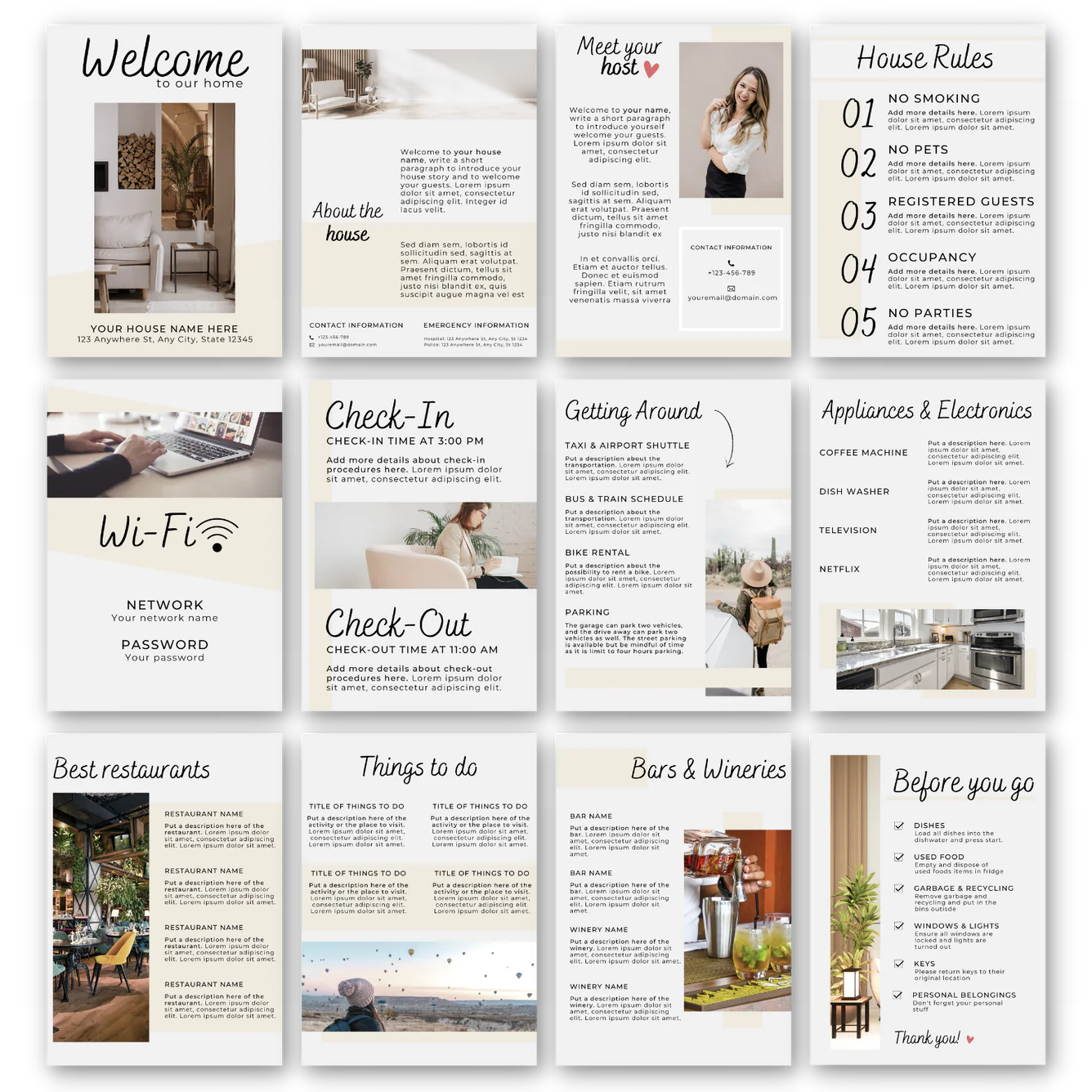
Somewhere along the way, the welcome book became "an Airbnb thing." Hosts on VRBO, on Booking.com, running a holiday let off their own website or taking direct bookings often assume the guest welcome book is a trick for one specific platform, and that it doesn't quite apply to them. It does. The platform a guest booked through changes almost nothing about what they need once they're standing in your hallway with their luggage. A good vacation rental welcome book template works exactly the same whether the booking came from Airbnb, VRBO, Booking.com, a holiday-let agency or a direct enquiry, because it answers the guest, not the channel.
I learned this running twelve villas in Azeitão, just outside Lisbon, for a concierge company. Those properties never lived on a single platform. The same villa might take an Airbnb booking one week, a direct booking the next, and a guest from another site the week after. The booking source kept changing. The welcome book on the kitchen table stayed exactly the same, because the questions guests asked never depended on where they'd clicked "reserve."
A welcome book answers the guest, not the platform
Think about what a welcome book actually does. It tells a tired arriving guest the Wi-Fi password, how to work the heating, where to park, the check-out time, and a couple of honest local recommendations. Not one of those things is specific to Airbnb. A family arriving at a holiday cottage they found on Booking.com needs the Wi-Fi just as badly as an Airbnb guest does. A couple who booked a villa directly through your website still has no idea how your oven works.
If anything, the welcome book matters more the further you get from the big platforms. Airbnb at least has a structured app where messages and basic details live. A direct booking or a smaller holiday-let site often has none of that scaffolding, so the document you leave in the home is the entire guest-facing system. The welcome book stops being a nice extra and becomes the whole operating manual for the stay. Everything I cover in my complete guide to the welcome book applies whichever way the guest found you.
Why it pays off on every channel
The benefits I measured across the villas didn't care about the platform either. A clear welcome book meant fewer messages, because the predictable questions (Wi-Fi, parking, check-out, how the AC works) were already answered. It meant calmer guests, because people who know how things work relax faster and leave warmer reviews. And it meant the home felt professionally run regardless of where it was listed.
There's a financial angle that hits hardest for hosts thinking beyond Airbnb. Direct bookings and bookings on lower-commission sites are where your margin actually lives, because you keep more of every night. The way you earn repeat direct bookings is by delivering a stay so smooth the guest wants to come straight back to you next time, skipping the platform entirely. A welcome book that makes the stay feel effortless is one of the quiet engines behind that loyalty. The platforms bring you the first stay. The experience inside the home is what brings the guest back directly.
What to put in a vacation rental welcome book
The structure I settled on holds up across every kind of property and every kind of booking. Here it is in order.
The first ten minutes
When a guest walks in, tired and travelling, a small number of things need to be impossible to miss: the Wi-Fi name and password, the check-out time and what to do on departure, where to park and how to get in, and how the basic appliances work. Put these right at the front. Whatever a guest needs in their first ten minutes shouldn't take more than ten seconds to find. If your guests let themselves in with nobody there to meet them, this section starts at the door, and I cover that handover in detail in my self check-in setup guide.
How the home works
This is the practical core, the part that prevents most messages: appliance instructions, heating and air conditioning, rubbish and recycling days, and any quirk specific to the property. Across the villas, every machine I didn't explain came back to me as a phone call, so this section earned its place fast. I go deep on it in my house manual checklist, which is really the engine inside the welcome book.
The house rules, kindly written
Every property needs a few rules, whatever platform it's on: no smoking, quiet hours, pool safety, the number of guests. The trick that survives across channels is tone. Rules written as a friendly reason plus a polite request get followed. Rules written like a warning sign get ignored.
Local recommendations
This is the part guests screenshot, and it's where you stop being a property manager and start being a host. A short, honest list of places you'd genuinely send a friend, grouped so it's easy to scan. In Casablanca, where I manage apartments today, this is the section guests quote back to me in reviews more than the apartment itself.
Safety and the boring-but-critical details
The fuse box, the water shut-off, the nearest pharmacy and hospital, local emergency numbers. Nobody reads it until they need it, and then it's the only section that matters. With international guests, a clearly written local emergency number isn't a detail, it's the most important line in the book.
A short, human welcome
Two or three warm sentences in your own voice set the emotional tone for the whole stay. They take thirty seconds to read and they make a stranger's house feel like somewhere they were expected.
Make it work in more than one language
If you host anywhere guests travel internationally, and on Booking.com especially you'll get a wide mix, the welcome book has to work for someone reading in their second or third language. During the World Cup in Qatar, my guests arrived from all over the world, and that taught me to keep the language plain and offer the key sections in more than one language. Even putting just the Wi-Fi, check-in and AC instructions in a couple of languages removes a surprising share of confused messages. A template that already includes several languages turns this from a translation project into a quick edit.
Build it once from a template, use it everywhere
Here's the practical reason this all comes together: you build a vacation rental welcome book once and it serves every channel at the same time. The same document goes out as a PDF before arrival, sits printed on the kitchen counter, and works identically for the Airbnb guest, the Booking.com guest and the direct booker. You're not maintaining a different system per platform. You're maintaining one good guest experience.
I don't start from a blank page, and I'd never tell you to. I build mine from a ready-made vacation rental welcome book template and just swap in the photos, Wi-Fi details and recommendations for each property. It's fully editable in a free Canva account, and if you want to follow the build click by click, I wrote a step-by-step Canva tutorial for exactly that. If you're setting up a property from scratch and want the checklists, posters and trackers alongside the book, the complete host toolkit bundle gives you the whole guest experience as one editable set, so a new holiday let feels professionally run from its very first guest.
Start your welcome book this week, whatever you host on
If your phone lights up with the same questions every stay, your welcome book should be answering them for you, no matter which platform sent the guest. If you're just starting out as a host, it's the first thing I'd build, because it shapes your reviews from guest one. And if you're working to grow direct bookings, it's one of the experiences that earns you the repeat guest who books you straight, not the platform.
You don't need design skills and you don't need a weekend. Start from a welcome book template you can make your own in minutes, add your details, and you'll have a book that works just as well for VRBO, Booking.com, a holiday let or a direct booking as it does for Airbnb. The platform is just where the guest found you. The welcome book is what they'll actually remember.