
The first set of house rules I ever wrote read like a parking ticket. "No smoking. No parties. No unregistered guests. Quiet after 10 p.m." I copied them from another listing, pasted them in, and felt organised. Then I spent the next year watching guests ignore them.
Running twelve villas in Azeitão, just outside Lisbon, for a concierge company taught me why. I was managing alojamento local at volume, which meant a dozen sets of guests at any moment, several of the villas with pools and gardens where the rules genuinely mattered for safety. When rules don't work across twelve properties, you notice fast, because every broken one becomes a phone call, a damaged garden, or a neighbour complaint. So I stopped copying other people's rules and started writing Airbnb house rules the way you'd explain something to a friend staying at your place. That one change did more for compliance than any threat ever did.
This is what I learned, with the actual wording I use today.
Why most house rules get ignored
Guests don't break rules because they're bad people. They break them because the rules were written to protect the host, not to help the guest, and people can feel the difference. A rule that reads like a warning sign makes a guest feel like a suspect before they've even put their bags down. A rule that reads like a friendly heads-up gets followed because it sounds like advice, not an accusation.
The second reason is placement. You can write perfect rules and bury them on page nine of a document nobody opens. With twelve villas, I learned that a rule only works where the guest actually meets it: by the door, by the bins, by the pool. More on that further down.
The rules every Airbnb actually needs
You don't need thirty rules. You need the handful that prevent real problems. Here are the categories I keep, and why each one earns its place.
No smoking
The most common rule, and the one with the most expensive consequences if ignored. Keep it warm but unambiguous.
> We're a non-smoking home, inside and on the balcony, so the next guests arrive to fresh air. If you smoke, the garden is all yours, and there's an ashtray by the back door.
Notice it gives the guest somewhere to go. A rule that only says "no" invites people to find a loophole. A rule that offers an alternative removes the temptation.
Quiet hours and parties
This is the one that protects your relationship with the neighbours, which in alojamento local is the relationship that keeps your licence alive. I never frame it as distrust.
> This is a quiet residential street and our neighbours are lovely. We ask for no loud music after 10 p.m. and no parties or extra visitors, so everyone (you included) sleeps well.
In Casablanca, where I manage apartments today, the buildings are close and sound carries, so I add one line naming the specific thing that travels: voices on the balcony late at night. Name the actual problem and guests self-correct.
Maximum occupancy and visitors
Short and clear. The booking is for the people on it.
> The home is set up for the guests on the reservation. Please don't bring extra overnight visitors without checking with us first.
Pool and garden safety
Several Azeitão villas had pools, and this is the rule I'd never soften past the point of safety. With families and children arriving, vague wording is dangerous.
> The pool has no lifeguard and no fence. Please watch children at all times, no diving in the shallow end, and no glass near the water.
This is the one place where being direct is the kind thing to do.
Pets
Whatever your policy, state it once and clearly, including the grey areas (assistance animals, a fee, where they can and can't go).
Check-out basics
Not a rule exactly, but it belongs with them because it's the thing guests forget last. I keep it to a short list: what time, where the keys go, start the dishwasher, windows shut. I go deep on the whole departure flow in my house manual checklist.
The tone trick that doubled compliance
Here's the single biggest lever, and it costs nothing. Write every rule as the reason plus the request, in that order.
Instead of "No wet towels on the beds," write "The mattresses are new, so please keep wet towels off the beds." Instead of "Turn off the AC when you leave," write "To keep our energy bills sane, please switch off the AC when you head out." The guest now understands why, and people follow rules they understand far more reliably than rules they're simply handed.
During the World Cup in Qatar, where I rented out apartments and villas to guests arriving from all over the world, this mattered even more. Someone reading your rules in their second or third language has no patience for tone they have to decode. Plain language, a clear reason, a polite request. That structure survives translation in a way that clipped warnings never do.
Where to actually put your house rules
A rule the guest never sees is not a rule. I put mine in three places, deliberately overlapping.
In the listing, so expectations are set before anyone books. This filters out the guest who wanted a party house before they ever message you.
In the welcome book, written in full with the friendly tone above. This is the reference copy, the one a guest reads on arrival when they're settling in. It sits inside the same document as everything else they need, which is the whole point of the welcome book: one calm place that answers questions before they're asked.
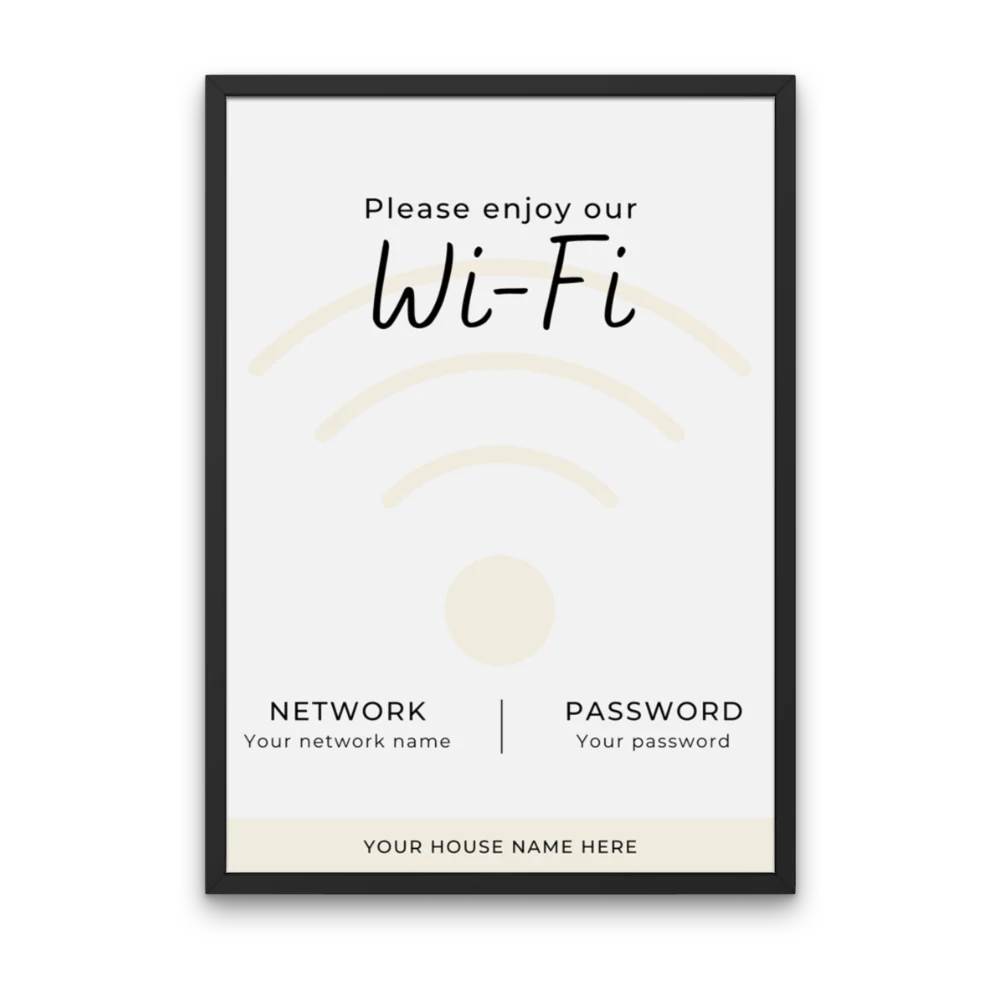
On small printed signs around the home, for the three or four rules people forget mid-stay. This is the part most hosts skip, and it's the part that actually changes behaviour. A guest doesn't reread the welcome book on day three. But a tidy little sign by the bins reminding them which day collection is, or one by the door about shoes, lands at the exact moment it's needed.
The trick is making those signs look like they belong, not like hostel notices taped to the wall. I keep a matching set of printable house rule posters in the same colours as the welcome book, so the place feels considered rather than covered in instructions. Across twelve villas, the difference between a wall of handwritten warnings and a clean, consistent sign was the difference between guests feeling policed and guests feeling looked after.
House rules examples you can copy today
Here's a compact starter set I'd be happy to leave in any of my properties. Adjust the specifics, keep the tone.
- Welcome: Make yourself at home. A few small things keep this place lovely for you and for the guests after you.
- Smoking: Non-smoking indoors and on the balcony. Smokers, the garden is yours.
- Quiet: Please keep noise down after 10 p.m. out of respect for our neighbours.
- Guests: Just the people on the booking, no extra overnight visitors without asking.
- Pool: No lifeguard on site, please supervise children and keep glass away from the water.
- Energy: Switch off the AC and lights when you go out, our bills thank you.
- Check-out: Keys in the lockbox, dishwasher on, windows shut. That's it.
Seven lines. Every one gives a reason or an alternative. None of them reads like a threat.
Make your rules part of the welcome, not a wall of no
House rules are not where you show guests you're in charge. They're where you show guests you've thought about their stay. The hosts whose reviews mention how easy and comfortable everything was are almost always the ones whose rules read like care, not control, and it's one of the quiet habits behind earning 5-star reviews.
Write the handful that matter, give each one a reason, and put them where the guest actually meets the moment: in the welcome book for the full picture, and on a clean set of printable posters for the reminders that land in the moment. If you're setting up the rest of your guest experience too, my self check-in guide covers the other half of arriving smoothly. Do this once, properly, and you'll stop policing your guests and start hearing how relaxed they felt.