
There's a specific kind of stress that only a host knows: it's 2 a.m., a guest is standing outside one of your properties on another continent's flight schedule, and the only thing between them and a bed is a four-digit code that had better work. Multiply that by twelve properties and a tournament's worth of international arrivals, and you understand why I stopped thinking of Airbnb self check-in as a convenience and started treating it as a piece of infrastructure that has to be built properly, once, so it never fails at the worst hour.
This is the setup guide I wish I'd had. Not the general "be welcoming" advice, the actual nuts and bolts: which access method to choose, how to set up a lockbox or a smart lock so it doesn't let you down, and how to write remote instructions a tired stranger can follow with nobody there to help. I built all of this running twelve villas in Azeitão, just outside Lisbon, for a concierge company, where being physically present at every door was simply impossible, and I stress-tested it renting out apartments and villas in Qatar during the World Cup, with guests landing at every hour from all over the world.
If you want the wider philosophy of a smooth arrival, the tone, the timing, the first ten minutes inside, I cover that in my guide to a smooth check-in experience. This piece is the technical half: the hardware and the exact words that make remote access actually work.
Choose your access method first
Everything else is built on this decision, so make it deliberately. The three options that actually hold up across real volume, in rough order of how much I trust them:
The smart lock with a code
My favourite once you're hosting seriously. You set a unique code per guest, valid only for their dates, and there's no physical key to lose, copy or fail to return. When a guest checks out, their code dies on its own. The convenience is real, but a smart lock introduces two failure points a plain lock doesn't have: power and connectivity. So the rules are non-negotiable. Check the battery between guests and never let it run low. Know exactly what happens if the wifi drops, most decent locks let a code work offline, but you need to have confirmed that, not assumed it. And always keep a physical backup way in for the day the electronics misbehave, because eventually they will.
The lockbox with a key
Simple, cheap, reliable, and it needs no power and no signal, which is precisely why I never fully retired it even where I had smart locks. A lockbox is a small metal box with a combination dial or buttons that holds a physical key. Its weak point isn't the box, it's people: guests don't put the key back, or they pocket it and walk off. Two habits fix almost all of it. Keep a spare key in a second location you can direct a guest to remotely. And state, clearly and more than once, that the key goes back in the box on departure. Mount the box somewhere solid and discreet, change the code between guests, and it'll serve you for years.
Key handover through a person
A neighbour, a concierge, a cafe downstairs that holds the key. It works, and for some buildings it's the only option, but understand that it quietly reintroduces the exact problem self check-in exists to solve: now an arrival depends on a human being available and awake. For one property with a friendly neighbour, fine. At any scale, it doesn't hold.
Whatever you pick, apply the one test that matters above all others: it has to work when you are asleep and unreachable. During the World Cup, with guests arriving at 3 a.m. from another time zone, "just message me and I'll sort it" was not a plan. The system had to be self-sufficient, and that single requirement should drive your whole setup.
Set the hardware up so it can't quietly fail
A lockbox or smart lock is only as good as the small operational habits around it. The mistakes I made early, and then never made again, all came down to skipping these:
- Reset the code between every guest. A code the last guest still knows is a security hole and an awkward conversation waiting to happen. Changing it is thirty seconds and it should be a fixed part of every turnover.
- Check the battery and the box on the turnover. Fold it into your regular turnover routine so the lock gets tested as a matter of course, not remembered in a panic. A dead battery discovered by a guest is a dead battery discovered far too late.
- Always have a backup way in. A spare key in a second lockbox, a code you can issue manually, a key with a trusted neighbour. The backup is the thing that turns a potential disaster, a guest locked out at midnight, into a two-minute fix.
- Mount it properly and discreetly. Solid fixing, somewhere a guest can find from your photo but a passer-by wouldn't notice. A lockbox dangling off a flimsy railing is asking for trouble.
Write remote instructions a tired stranger can follow
This is where most self check-ins actually fail, not at the hardware, but at the explanation. The host knows their own door so intimately that they forget how much they're assuming. They write "the lockbox is by the entrance," and the guest is standing in the dark outside a building with three entrances, suitcase in hand, with no idea which door, or what a lockbox even looks like.
The fix is to write every instruction for someone who has never been there, is tired, may be reading in a second language, and might have no phone signal at the door. In practice that means:
- An address that actually works in a map app, plus a landmark. "The blue door next to the pharmacy" beats a street number every time.
- Photos of everything. The building, the specific door, the lockbox, exactly where it's mounted. A photo removes the guesswork words can't. Across the villas, adding a picture of each gate and key box cut my "I can't find it" messages to almost nothing.
- The steps in order, numbered, from "arrive at this corner" to "you're inside, the light switch is on your left."
- The code or key location stated plainly, and how to lock up too, including the reminder that the key goes back in the box.
- A what-if line. What to do if the code fails or they're stuck, with your number, so a problem has an answer instead of a spiral into panic.
Before I trust any set of instructions, I run one test: I hand them to someone who's never been to the property and ask them to "arrive" using only the document, with no help from me. Wherever they hesitate is the line I rewrite. It's the same cold-read test I use for the whole house manual, and it catches the assumptions you're blind to because you already know the answer.
Time the messages so the answer is always to hand
Perfect instructions are useless if they arrive while the guest is already lost at the door. The sequence that worked across twelve villas:
- At booking: a warm note saying full check-in details will arrive the day before, so the guest isn't anxious about it in the meantime.
- The day before arrival: the complete instructions, with address, photos, code or key location, and parking, early enough to read on the way to the airport rather than in a doorway.
- A few hours before arrival: a short "looking forward to having you, here's the key info again" nudge, so it sits at the top of their messages exactly when they need it.
Done this way, the guest never has to dig back through a chat thread at the worst moment. The most recent message is always the answer.
Don't stop at the door
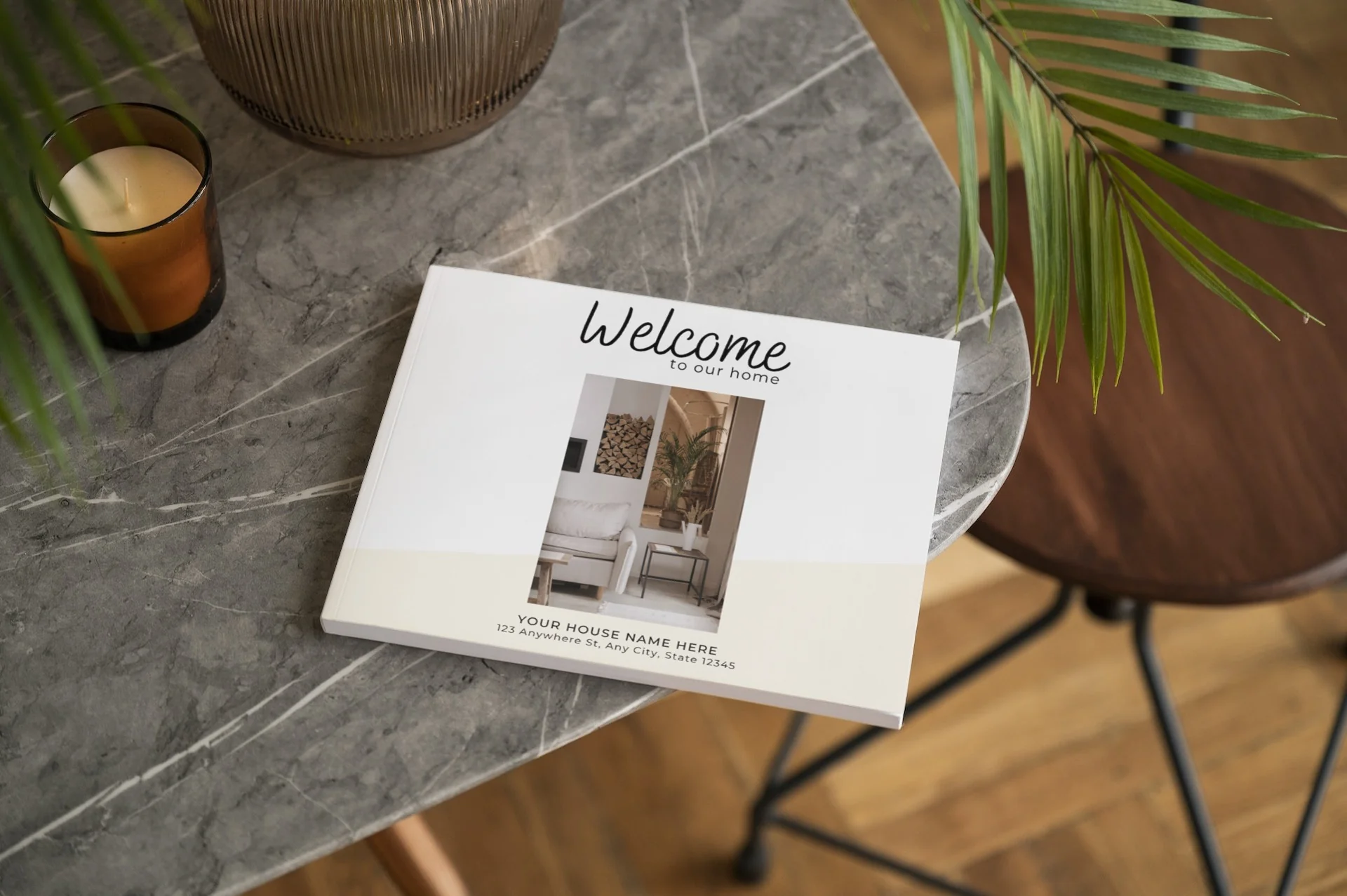
Getting the guest inside is the access problem solved, but the arrival isn't over the second the door opens. They step into an unfamiliar home and immediately need the Wi-Fi, the heating or AC, and a sense of what to do now. If self check-in dumps them inside and then goes silent, the relief of getting in is instantly replaced by a new round of confusion. I never treat the door code and the welcome book as separate jobs, they're one continuous arrival. The welcome book is what carries the guest from "I'm in" to "I'm settled," and I keep the check-in steps and the welcome book in the same document so there's one place for everything from the doorstep onward. The appliances they'll reach for first deserve the same clarity, which is why I keep clear appliance instructions right there alongside the access notes.
Back the key moments with signage
Even with flawless instructions, a couple of things slip the moment a guest is inside and distracted: how to actually lock the door on the way out, which key goes where, the Wi-Fi. For those I back up the welcome book with small printed signs placed exactly where the moment happens, a tidy note by the door, one by the lockbox. A clean set of printable posters handles this without making the home look like a help desk, and it closes the loop on the few things people forget right after letting themselves in.
A reliable self check-in runs itself
Get this built properly and self check-in stops being a source of late-night dread and becomes the quiet machine that lets you host without being chained to a doorway. Pick an access method that survives you being asleep, set the hardware up with backups and a code that resets every turnover, write instructions a tired stranger could follow with no signal, and time your messages so the answer is always the latest one. The guests who leave the warmest reviews almost always mention how easy it was to arrive, and an effortless arrival is one of the surest foundations of the 5-star reviews that follow.
When you're ready, start from a proper welcome book template that holds your check-in steps and everything after, and back it with a few printable posters for the moments people forget. Build it once, and your arrivals will run themselves, even at 3 a.m. when you're fast asleep.