
For my first year of hosting, my "accounting system" was a folder of screenshots and a vague feeling that things were going fine. They probably were. But when it came time to actually understand what each property earned, after cleaning, after fees, after the new mattress and the plumber and the restocked toiletries, I had no real answer. I could tell you my payouts. I could not tell you my profit. Those are very different numbers, and the gap between them is where a lot of hosts quietly lose money.
Running twelve villas in Azeitão for a concierge company forced me to fix this fast. With alojamento local at that scale, "it feels fine" is not a strategy. Twelve properties meant twelve streams of income and twelve streams of expenses, and without a system I'd have had no idea which villas were actually worth the effort and which were just busy. Learning to track Airbnb income and expenses properly, across those villas and later through the apartments I rented out in Qatar during the World Cup and the ones I manage in Casablanca today, changed how I made every decision.
Here's what I track, how, and why it pays off far beyond tax season.
Payout is not profit
This is the trap, so let's name it first. The number Airbnb pays into your account is revenue, not earnings. By the time a booking actually lands in your pocket, it has usually passed through:
- Platform service fees
- Cleaning costs for the turnover
- Restocking consumables (coffee, toiletries, paper)
- A share of your fixed monthly costs (utilities, internet, subscriptions)
- The slow drip of maintenance and replacements
A villa that looks like a star performer on payouts can quietly be a mediocre one on profit, because it eats cleaning and maintenance faster than it earns. You only see that once you track both sides. Across the twelve villas, two of my "busiest" properties turned out to be my least profitable once I accounted for how often things broke. I'd never have known from the payout screen.
What to record on the income side
Income tracking is the easy half, but do it per property and per booking, not as one big monthly lump, or you lose the detail that makes it useful.
For each booking I record:
- The property
- Check-in and check-out dates and nights booked
- Gross amount the guest paid
- Platform fees deducted
- Net payout received
- The channel (Airbnb, a direct booking, another platform)
That last one matters more than people expect. When you can see what each channel actually nets you after its fees, you can decide where to push your energy. Direct bookings through my own welcome book and guest experience carried no platform commission, so over time I worked to turn happy guests into repeat direct bookings, and to fill the gaps through a commission-free channel like Instagram. The tracker is what showed me that effort was paying off.
What to record on the expense side
This is the half most hosts neglect, and it's the half that protects you at tax time. Split expenses into two buckets.
Per-property recurring costs, the ones tied to a specific home:
- Cleaning and laundry per turnover
- Consumables restocked between guests
- Utilities, internet, and any property-specific subscriptions
- Repairs and maintenance for that property
- Furnishings and replacements
Shared business costs, the ones that aren't tied to one home:
- Software and template tools
- Photography
- Insurance
- Your time, if you want an honest picture of whether managing it yourself is worth it
Log expenses as they happen, not in a panic at year end. A receipt photographed and recorded the day it's spent takes ten seconds. The same receipt found in a coat pocket eight months later, faded and half-remembered, is an hour of detective work and probably a deduction you'll miss. With twelve villas I learned to log on the spot, because the alternative was a December I never want to repeat.
The numbers worth watching
Once income and expenses live in the same place, a few figures start telling you how the business actually runs.
- Net profit per property. The real one, payouts minus that property's full share of costs. This is the number that tells you which homes deserve more of your attention, and it's the figure I lean on most when I'm managing multiple properties at once.
- Occupancy rate. Nights booked against nights available. A high rate at a low nightly price can earn less than a lower rate at a stronger price.
- Average cost per turnover. When this creeps up, something in your cleaning or restocking has drifted. A consistent cleaning checklist keeps both quality and cost predictable.
- Cost per booking. Total expenses divided by bookings, so you know what each guest actually costs you to host.
You don't need to be an accountant to read these. You just need them in one view, updated as you go.
Why this matters beyond tax season
Tax is the obvious reason, and it's a real one. A clean record of income and deductible expenses means you (or your accountant) aren't reconstructing a year from memory, and you don't overpay because you forgot half your costs. As a UK company selling and operating across borders, my own setup has its complications, and I'm grateful every year that the raw numbers are already in order before anyone looks at them.
But the bigger payoff is decisions. Tracking is what let me answer the questions that actually grow a hosting business: Which property should I invest in? Is this one worth keeping? Did raising the nightly rate help or just lower occupancy? Was the World Cup period in Qatar as lucrative as it felt, once I counted the extra wear and the higher turnover costs? A tracker turns hosting from a feeling into a thing you can steer.
Keep it simple enough to actually use
The best tracking system is the one you'll still be using in month six. I've watched hosts (and myself, early on) build elaborate spreadsheets so complicated that updating them becomes a chore, and a chore gets skipped. The moment you skip it, the data has a gap, and a tracker with gaps lies to you.
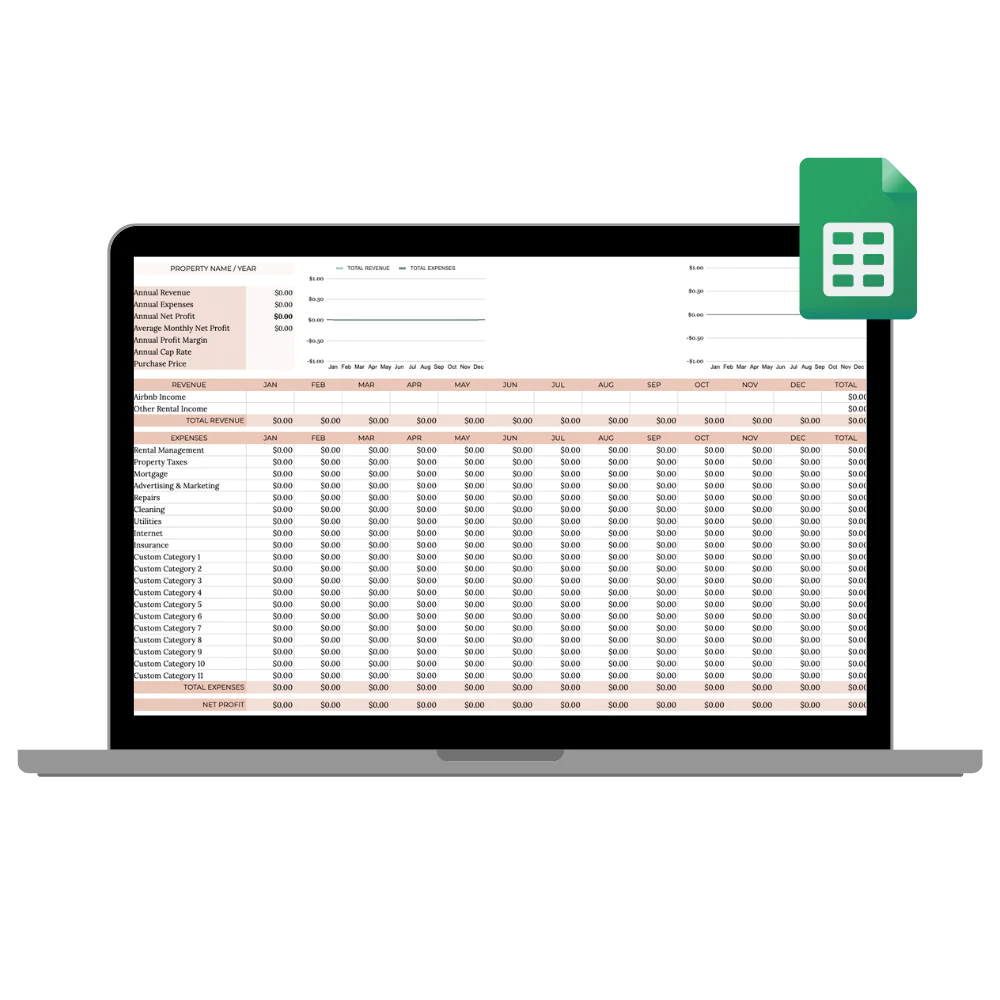
So I keep mine deliberately simple: one place, per property, income and expenses side by side, updated little and often rather than in heroic year-end sessions. I use a ready-made Airbnb income and expense tracker that already has the categories and the per-property breakdown laid out, so I'm just typing numbers in, not building formulas. Because it's editable, I can add a category specific to how I work without rebuilding the whole thing. The point is to spend your time hosting, not maintaining a spreadsheet.
Start tracking from your next booking
You don't need to reconstruct your whole year tonight. If you're only just becoming a host, building this habit from your very first booking is one of the smartest moves you can make. Start with your very next booking and your very next expense, and record them the day they happen. Add the property, the gross, the fees, the net. Photograph the next receipt and log it. Do that consistently and within a month you'll know more about your business than you did in your first whole year of hosting.
When you're ready to do it properly, start from an income and expense tracker you can fill in from your next booking, and back it with a clean welcome book and a steady cleaning routine so the costs you track stay predictable. Profit you can see is profit you can grow.