
Renting out the rooms of one house separately is the most underrated format in hosting, and the most delicate. On paper it is simple: a three-bedroom house becomes three listings, three calendars, three streams of guests, and often more income than the whole house would make rented as one. In practice it means strangers sharing the same kitchen, a check-in happening while another guest eats breakfast, and turnovers to run in a house that is never completely empty.
I come from whole-property hosting: the twelve villas I ran in Azeitão, just outside Lisbon, the apartments in Qatar during the World Cup, the ones I manage in Casablanca today. But it was Qatar, with demand far beyond anything the city could absorb, that put me in the middle of this format. I rented the rooms of one large villa to different groups, with arrivals at every hour and guests from different countries under the same roof. Those weeks were the crash course. Renting separate rooms on Airbnb only works when every detail that stays implicit in a whole property is made explicit, in writing, before it turns into an argument between two strangers in a corridor.
Here is the method, piece by piece.
One listing per room, and the word that decides everything is honesty
Each room is its own listing, with its own calendar and its own price. That part is mechanics. The part that decides your reviews is how you write those listings.
The rule that has saved me the most trouble: the guest has to understand exactly what is theirs and what is shared before they book. "Private room" belongs in the title, always, because a share of guests book in a hurry and are then surprised to find other people in the kitchen. In the description I spell it out without dancing around it: private bedroom with a lock, bathroom shared with one other room (or private, if it is), kitchen and living room in common, and how many other bedrooms there are in the house.
The photos follow the same logic. The room first, then the shared spaces labelled as shared, with a caption that says so. One ambiguous shot of a living room that looks private costs you a disappointed review. An honest private room listing filters for you: whoever wants total isolation does not book, and whoever books arrives already calibrated. A surprised guest is an unhappy guest, and in a shared house surprises multiply by the number of rooms.
One small thing almost nobody does: give every room a name (ours were colours, the blue room, the green room) and use it everywhere, in the listing, on the door, in your messages. With three calendars running, "the blue room" prevents the mistake you will eventually make with "room 2".
Calendars and arrivals: the risk is not a double booking, it is a collision
With whole properties, the enemy on the calendar is the overlap. With multiple rooms in one house, bookings overlap by definition, so the enemy becomes the arrival collision: two check-ins at the same hour, or a guest walking in while I am cleaning the room next door and the place looks like a building site.
Three habits fix nearly all of it:
- Staggered check-in windows. If a room empties and refills the same day, I give the arriving guest a window that starts after the realistic end of the clean, not the optimistic one.
- Self check-in for every room. A lockbox or a code lock on the front door and on the bedroom door. That way an arrival does not depend on me and does not disturb the other guests, and it works at 11 p.m. as well as at 3 p.m. It is the same flow I use for whole properties, and I set it out in my self check-in guide.
- A pre-arrival message that names the sharing. One line: "There are guests staying in the other rooms too, so the kitchen is shared and your bedroom locks with your own code." Whoever reads it arrives without surprises, and the sentence costs ten seconds to write.
House rules do twice the work in a shared house
In a whole property, rules protect you and your neighbours. In a house rented by the room, they mostly protect the guests from each other, and that is a big difference: quiet after 10 p.m. is no longer a courtesy to the street, it is what lets the guest in the next room sleep before an early flight.
The rules that earned their place in my shared houses: quiet hours, no outside visitors (in a shared house, one extra stranger is a stranger in everybody's home), kitchen cleaned after use with one shelf assigned per room, shared bathroom left the way you would want to find it, and laundry time slots if you need them. Few of them, written kindly, with the reason in front. The tone that works is the same one I use everywhere, and I wrote out the exact wording in my Airbnb house rules examples.
And because nobody in a shared house rereads anything on day three, the three rules that matter also live on small signs, at the exact spot where they apply: by the bins, in the kitchen, next to the washing machine.
Cleaning a house that never empties
Here is the operational part nobody warns you about: when you rent rooms separately, the turnover happens while the other guests are living there. You cannot throw every window open, put music on and sweep through the place top to bottom. You have to work in compartments.
My system runs on two tracks. The first is the single-room turnover: one checklist for the bedroom and, if it has one, its private bathroom, identical every time, whoever runs it. Linen, surfaces, under the bed, bin, final reset with the room's welcome book back on the nightstand. It is the same room-by-room logic as my cleaning checklist guide, just cut to the right perimeter.
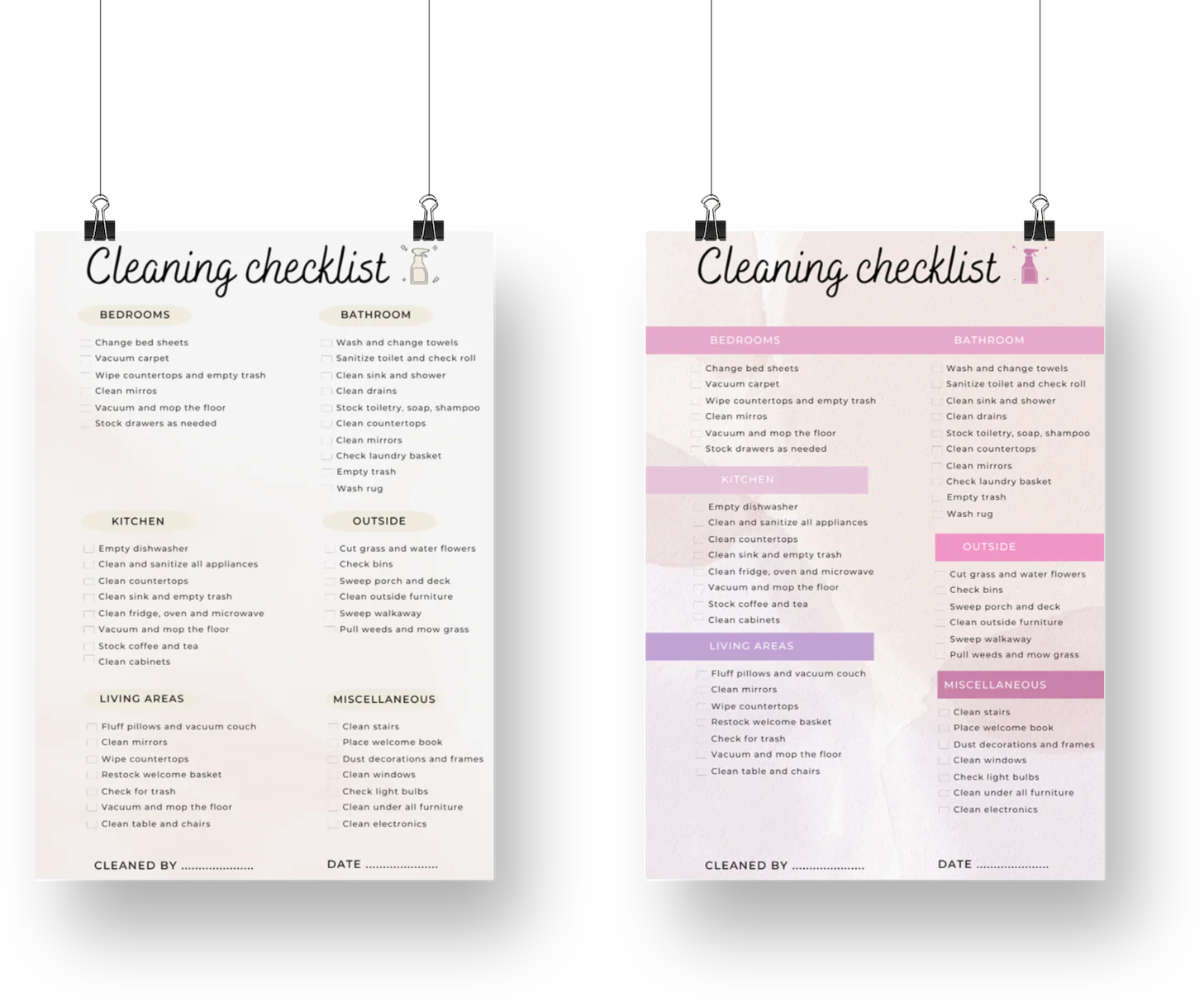
The second track is the shared spaces, on a fixed rhythm: kitchen and shared bathroom every day or every other day, at a predictable time announced in the welcome book ("the kitchen is tidied every morning between 11 and 12"). The fixed time does two things: guests never feel walked in on, and the standard stops depending on how tidy the last person to cook happened to be. I keep a printable checklist inside the cleaning cupboard, ticked at every pass, because with several guest streams running in parallel, memory is not a system and a checklist is.
Locks and privacy: trust gets built at the hardware shop
A house rented by the room stands on one thing: every guest has to be able to close a door behind them. A lock on every bedroom, always, with a code or a key given to that guest only. That is what turns "a room in a house full of strangers" into "my own space, plus a kitchen I share". Add a safe spot for valuables if you can, decent curtains, and a night light in the corridor: small details, better reviews.
And say the lock in the listing. For a lot of guests, especially solo travellers, "your bedroom locks" is the line that decides the booking.
A welcome book per room, not per house
In a house rented by the room, the welcome book splits in two, and this is where I saw the sharpest drop in questions. Every bedroom gets its own book, on the nightstand, with two sections:
- Your room: Wi-Fi on the first page, how the AC or the heating in that room works, the door code, check-out.
- The shared house: the kitchen shelf assigned to the room, shared bathroom timings if you use them, bin days, quiet hours, and your local recommendations.
The shared section is identical in every book, so you write it once and duplicate it. I start from the English welcome book template, fully editable with a free Canva account: I build the first room's book, then duplicate the file and change only the first section. Three rooms, one afternoon, and every guest has their own answers without having to ask anyone, which in a shared house counts double. The question they do not ask you is also the question they do not ask the wrong guest in the corridor.
The numbers: read your rooms one at a time
What was true for my villas is true for rooms: money looked at in one pile lies to you. Three rooms feel like "the house that does well", until you split the numbers and find that the small room with the shared bathroom earns half what the other one does while generating twice the turnovers, which means twice the work. Tracking income and costs per room tells you where to raise the price, where a private bathroom would pay for itself, and which room you might stop selling by the night and offer for long stays instead.
When renting rooms separately pays, and when it does not
The practical truth, from someone who has done both: rooms rented separately earn more per night in total, almost always, and cost more in operations, always. More messages, more turnovers, more friction available. They pay when the house suits it (bedrooms that lock, shared spaces worth sharing, ideally more than one bathroom) and when your typical guests are solo travellers, people in town for work, short city stays. They pay less with families and groups, who want the whole house and are happy to pay for it.
If the format works for you and you grow, the next step looks a lot like my own path with the villas: written systems, not memory and heroics. Everything I use to keep several places running at once is in my guide on how to manage multiple Airbnb properties, and every line of it holds when your "properties" are three doors along the same corridor.
Start with the next room you have free: a lock on the door, an honest listing, a welcome book on the nightstand and a checklist in the cupboard. The rest of the shared house falls into line on its own, one calm guest at a time.